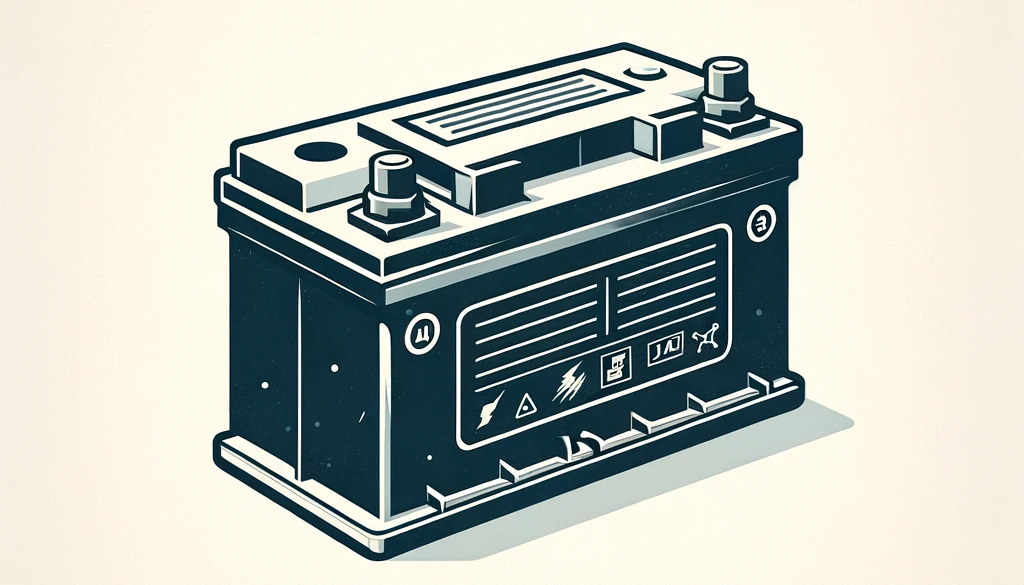
- Check electrolyte levels monthly (flooded batteries only) — top up with distilled water only
- Keep batteries charged above 50% — never store discharged
- Use a battery maintainer during long storage periods
- Clean terminals annually — baking soda solution + wire brush + anti-corrosion spray
- Perform a capacity test annually — charge to full, discharge to 50%, compare runtime
- For LiFePO4: store at 50% charge, disconnect BMS if storing more than 3 months
Your RV’s house battery bank is what separates camping from glamping. A well-maintained battery bank provides lights, refrigeration, fans, and electronics for days without hookups. A neglected one fails at the worst possible moment — in a remote campsite, in freezing temperatures, when you need it most. This guide covers everything you need to keep your RV house batteries in top condition.
Types of RV House Batteries
The three main battery types used in RV house banks each have different maintenance requirements:
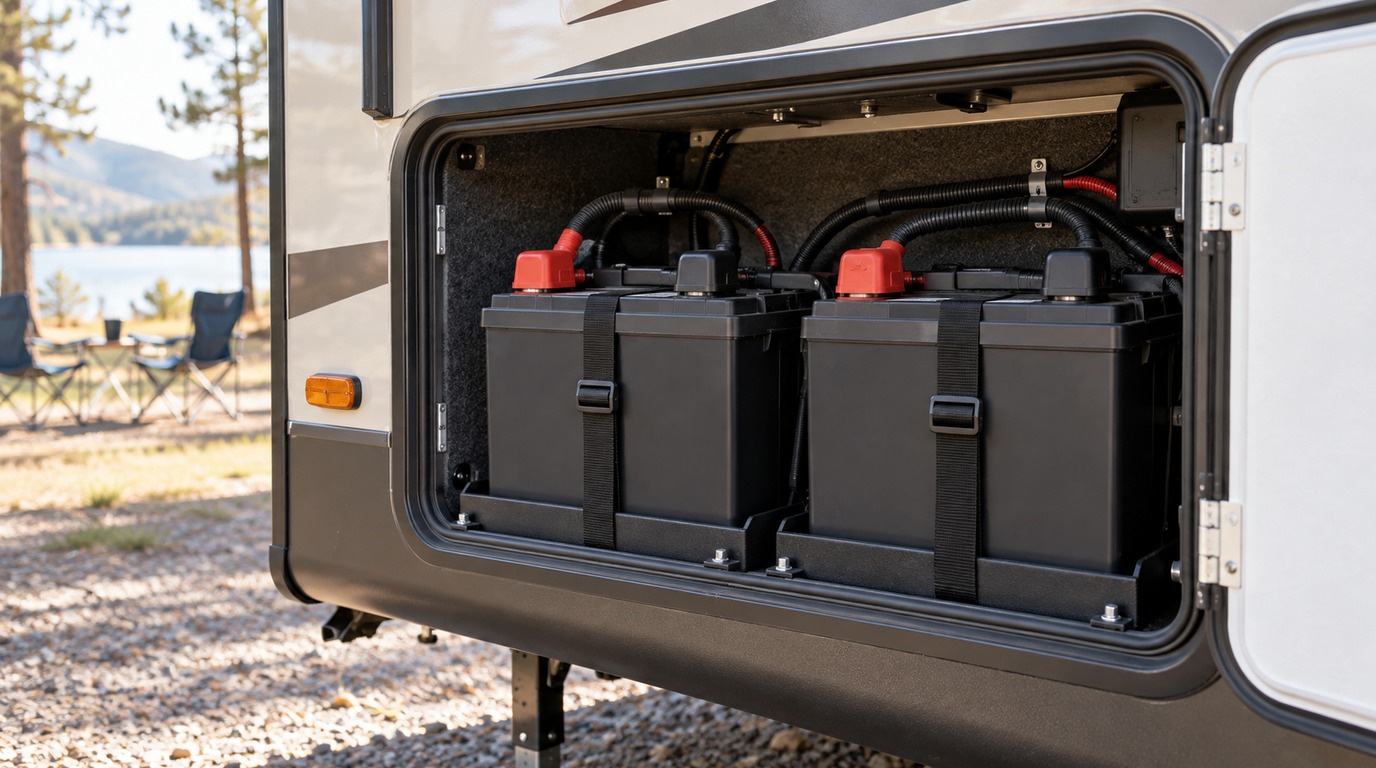
Flooded Lead-Acid (FLA)
The original RV battery. Low cost, widely available, but requires regular maintenance — specifically, checking and topping up electrolyte levels with distilled water. They gas (release hydrogen) during charging, which means ventilation is important and electrolyte is lost over time. Deep discharges below 50% significantly shorten life.
AGM (Absorbed Glass Mat)
Sealed, maintenance-free, and more tolerant of the vibration and varied mounting positions typical of RV use. More expensive than flooded (2–3x), better cycle life (300–500 cycles at 50% DoD), but still lead-acid with the same 50% DoD limitation and typical 2–4 year deep-cycle life in RV use.
LiFePO4 (Lithium Iron Phosphate)
The premium upgrade. 80–100% usable depth of discharge (vs 50% for lead-acid), 2,000–5,000 cycle life, 50–70% lighter, and essentially maintenance-free. The upfront cost is 3–5x lead-acid but the total cost of ownership over 5–10 years typically favors lithium. Increasingly the default choice for new RV builds and upgrades.
How to Check RV Battery Health
Voltage Check
With a multimeter, measure resting voltage at least 2 hours after any charge or discharge activity:
| Voltage (12V system) | Lead-Acid State of Charge | LiFePO4 State of Charge |
|---|---|---|
| 12.7V+ | 100% | ~95–100% |
| 12.5V | 75% | ~80% |
| 12.2V | 50% | ~30% |
| 12.0V | 25% | ~10% |
| 11.8V | 0% (critical — charge immediately) | ~5% |
Capacity Test
Voltage only tells you state of charge, not battery health. To assess actual capacity: charge to 100%, then run a known load (e.g., your 50W fan = ~4A at 12V) and time how long before the battery reaches 50% (12.2V for lead-acid). Compare to the expected runtime based on rated capacity. A battery at 60% health delivers 60% of the expected runtime.
Charging Your RV Batteries Correctly
Shore Power / Converter
Most RV converters have a built-in battery charger. Older converters (pre-2010) often use a simple unregulated charge that can overcharge and damage batteries over time. If your converter is old and your batteries are aging faster than expected, upgrading to a smart 3-stage converter (bulk → absorption → float) makes a significant difference. Progressive Dynamics, WFCO, and Magnetek make excellent replacement converters.
Solar Charging
Solar is the most battery-friendly charging method for RVs because it provides a gentle, steady charge rather than the high initial current of shore power. Use an MPPT charge controller for best efficiency — it typically delivers 15–30% more power than PWM controllers. Set the controller’s battery type correctly (flooded, AGM, or LiFePO4) for appropriate charging voltages.
Generator
Generator charging through the converter is effective but loud and uses fuel. Use it for recovery charging (getting back to 80%+ from a low state) rather than topping off, and shut it down once the converter moves to absorption mode to save fuel.
Alternator (Tow Vehicle / Chassis)
The alternator charges the chassis battery, and optionally the house bank through a battery isolator or DC-DC charger. Standard battery isolators are adequate for lead-acid but suboptimal for LiFePO4 — LiFePO4 can accept very high charge rates that trip the alternator’s thermal protection. A DC-DC charger (Victron Orion, REDARC) limits alternator current and provides proper multi-stage charging for the house bank.
Preventing Over-Discharge
Over-discharge is the leading cause of premature lead-acid battery failure in RVs. Best practices:
- Install a battery monitor (Victron BMV, Renogy BT-1) that shows actual state of charge, not just voltage — voltage is unreliable as a SoC indicator under load.
- Set a low-voltage disconnect at 11.9–12.0V for lead-acid (approximately 50% SoC) to automatically disconnect non-essential loads before the battery gets critically low.
- For LiFePO4: the BMS handles low-voltage cutoff, but monitor SoC to avoid repeated deep discharges unnecessarily.
Winterizing RV Batteries
Lead-Acid
- Fully charge before storage — a discharged lead-acid battery will freeze at 0°F (-18°C); a fully charged one won’t freeze until -70°F (-57°C).
- Connect a smart battery maintainer (Battery Tender, CTEK MXS or Victron Blue Smart) if stored in a location with power access. Maintainers prevent self-discharge and sulfation without overcharging.
- If storing without power: disconnect the battery and store in a cool, non-freezing location. Check and recharge monthly if storage exceeds 30 days.
LiFePO4
- Store at 50% state of charge (not full) to minimize calendar degradation.
- LiFePO4 has low self-discharge (~2–3% per month), so a battery stored at 50% in October will still have usable charge in spring.
- Many LiFePO4 BMS units have a storage mode or sleep mode — activate it to reduce parasitic drain from the BMS electronics.
- LiFePO4 handles cold storage (down to -40°F) without the freeze risk of lead-acid. Just ensure the BMS prevents charging if the battery is below 32°F (0°C).
Upgrading from Lead-Acid to LiFePO4
If your lead-acid batteries are due for replacement, seriously consider upgrading to LiFePO4. The practical steps:
Compare the RV battery buying options and review AGM versus flooded lead-acid construction when deciding which maintenance requirements suit your setup.
- Verify charger compatibility: Your converter and any solar charge controllers must be LiFePO4 compatible (support 14.4–14.6V charge voltage). Many modern smart chargers are compatible; some older converters need replacement.
- Check battery compartment size: LiFePO4 batteries are significantly lighter but may have different dimensions than your existing batteries. Measure carefully.
- Consider a DC-DC charger if charging from the alternator: Protects the alternator and provides proper LiFePO4 charging.
- Optional — add Bluetooth BMS monitoring: Allows you to monitor individual cell voltages and state of charge from your phone.
Frequently Asked Questions
How often should I water my RV flooded batteries?
Check electrolyte levels monthly during active use and before any extended storage. In hot summer conditions with heavy use, some batteries need watering every 2–3 weeks. Only add distilled water — tap water minerals contaminate the electrolyte. Add water after charging (not before) so you can see the correct level without acid dilution from a partial charge. Water should cover the plates by about 1/4 inch but not overflow into the vent caps.
Why do my RV batteries keep dying even when plugged in?
Most likely cause: your converter/charger is aging and only providing a trickle charge or has failed to bulk charge mode. Test by measuring battery voltage while plugged in — should be 13.2–14.4V during charging, settling to 13.2–13.4V at float. Below 12.8V while plugged in indicates the charger isn’t working properly. Second possible cause: a parasitic load (a small draw from an appliance or electronics staying on) is draining the battery faster than the charger can maintain it.
Can I mix old and new batteries in my RV battery bank?
Avoid it when possible. Mixing batteries of different ages and capacities causes the older/weaker battery to limit the entire bank’s capacity and cycle life. The stronger batteries try to compensate for the weaker one, causing uneven charge distribution. If you must mix, match the chemistry (all flooded, all AGM, all LiFePO4) and add the new battery only if the older one still has 80%+ capacity.
How do I know if it’s the battery or the converter causing my RV electrical problems?
Test them separately. For the battery: disconnect from the converter, charge fully with a standalone charger, then load test — run a known load and verify it delivers expected runtime. For the converter: with a known-good battery connected, measure the output voltage at the battery terminals while plugged into shore power. 13.2–14.4V indicates the converter is working; lower indicates converter failure.