A good battery charger is one of those tools that pays for itself the first time it saves you a tow. Whether you’re maintaining a stored vehicle, recovering a dead battery, or conditioning an old battery bank, the right charger makes a significant difference. Here’s what’s actually worth buying in 2026.
Charger vs Maintainer: What’s the Difference?
- Battery charger: Actively charges a battery from a low state to full. Has meaningful output current (4–50A). Can recover deeply discharged batteries. Not designed for indefinite connection.
- Battery maintainer (tender): Low-output device (0.75–1.5A) designed for indefinite connection. Monitors battery voltage and tops it up when it drops. Cannot effectively charge a deeply discharged battery — too slow. Use for stored vehicles, boats, motorcycles, seasonal equipment.
- Smart charger: Combines both. Charges at higher current when needed, then automatically drops to maintenance mode when full. The best all-in-one choice for most people.
What to Look For
- Output current: A 10A charger brings a dead battery to 80% in about 2 hours. For normal use, 4–10A is plenty.
- Battery type compatibility: Verify support for your chemistry — flooded, AGM, gel, and LiFePO4 are not all supported by every charger.
- Smart algorithm: Multi-stage charging (bulk → absorption → float) and desulfation/repair mode protect battery health.
- Safety features: Reverse polarity protection, spark-proof clamps, and temperature compensation are essential.
Our Top Picks
Best Overall: CTEK MXS 10 (10A)
CTEK is a Swedish brand with a decades-long reputation for quality smart chargers used by workshops and enthusiasts worldwide. The MXS 10 handles 12V batteries at 10A with an 8-step automatic charging program covering reconditioning (desulfation), bulk charge, absorption, analysis, and maintenance. Compatible with flooded, AGM, GEL, and calcium batteries. The built-in temperature sensor adjusts charge voltage for ambient conditions — essential for outdoor use in varying climates. Around $120–140.
- Output: 10A, 12V
- Chemistries: Flooded, AGM, Gel, Calcium (not LiFePO4 — see Victron for lithium)
- Features: 8-step program, recondition mode, temperature compensation, IP44 splash-proof
- Best for: Main charger for all lead-acid applications
Best Premium with Bluetooth: Victron Blue Smart IP65 12/10
Victron Energy is the benchmark brand for serious energy systems — used in yachts, RVs, and off-grid installations worldwide. The Blue Smart IP65 charger brings that quality to a compact home charger with Bluetooth connectivity. The companion app shows real-time charge current, voltage, and charge phase. Supports flooded, AGM, gel, and LiFePO4 (lithium) — the only one on this list with lithium support. IP65 rated (fully dust-tight, water jet resistant). Around $100–130.
- Output: 10A, 12V
- Chemistries: Flooded, AGM, Gel, LiFePO4
- Features: Bluetooth app monitoring, IP65, adaptive algorithm
- Best for: LiFePO4 batteries, anyone wanting monitoring visibility, professional use
Best Maintainer: Battery Tender Plus 12V 1.25A
Battery Tender (Deltran) essentially invented the modern smart battery maintainer category. The Plus model is the gold standard for maintaining stored vehicles — motorcycles, classic cars, boats, jet skis, ATVs. Refined over 30+ years, with a rock-solid reputation for reliability. Designed for leaving connected for months. The ring terminal harness makes installation permanent and foolproof — just plug in when storing, unplug when you ride. Around $35.
- Output: 1.25A, 12V
- Chemistries: Flooded, AGM
- Best for: Indefinite storage maintenance of motorcycles, classic cars, seasonal vehicles
Best Budget Fast Charger: Schumacher SC1281 (15A/30A)
Schumacher has been making battery chargers for over 60 years. The SC1281 offers multiple charge rates (3A maintain, 15A standard, 30A fast) with automatic mode selection based on battery size and charge state. LCD display, microprocessor-controlled, with engine start assist. Handles flooded and AGM. Less refined than CTEK or Victron but gets the job done at a lower price point — around $65–75.
- Output: 3A / 15A / 30A selectable, 12V
- Chemistries: Flooded, AGM
- Best for: Shops that need fast charging capability on a budget
Comparison Table
| Charger | Output | LiFePO4 | Bluetooth | Price | Best For |
|---|---|---|---|---|---|
| CTEK MXS 10 | 10A / 12V | No | No | ~$130 | All lead-acid, main charger |
| CTEK MXS 5.0 | 5A / 12V | No | No | ~$80 | Single vehicle, lighter use |
| Victron Blue Smart 12/10 | 10A / 12V | Yes | Yes | ~$120 | Lithium batteries, monitoring |
| Victron Blue Smart 12/5 | 5A / 12V | Yes | Yes | ~$85 | Compact, lithium support |
| Battery Tender Plus | 1.25A / 12V | No | No | ~$35 | Long-term storage only |
| Battery Tender Lithium | 1.25A / 12V | Yes | No | ~$40 | Lithium storage maintenance |
| Schumacher SC1281 | 3/15/30A / 12V | No | No | ~$70 | Fast charge, budget |
CTEK vs Victron vs Battery Tender vs Schumacher
CTEK: The professional’s choice for lead-acid batteries. Trusted by OEM workshops across Europe. Best-in-class reconditioning algorithm. No lithium support but the most refined lead-acid charging program available.
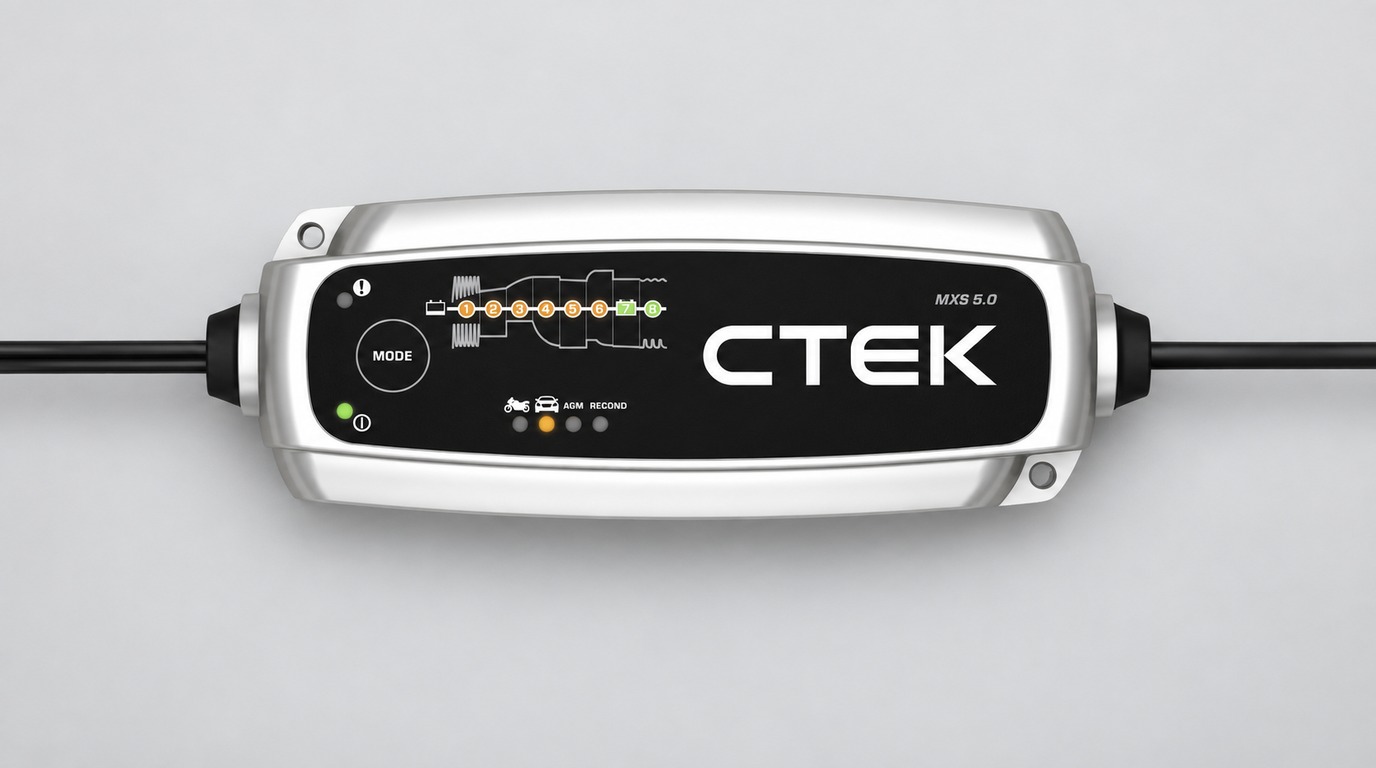
For a smaller CTEK model, read the MXS 5.0 review. If recovery is your goal, review the limitations discussed in car battery reconditioning before using a charger recovery mode.
Victron: Best choice if you have or plan to have lithium (LiFePO4) batteries, or if Bluetooth monitoring is important. Victron’s ecosystem (MPPT solar controllers, inverters, BMSs) integrates seamlessly. Slightly higher cost but worth it for the versatility.
Battery Tender: Best for pure storage maintenance of a single vehicle. Simple, proven, indestructible. Get the 12V Plus for flooded/AGM, the Lithium version for LiFePO4.
Schumacher: Good budget option with higher amperage for fast charging. Less refined algorithm but gets the job done for basic flooded/AGM charging.
Frequently Asked Questions
Can I leave a smart charger connected permanently?
Yes — smart chargers and maintainers that automatically switch to float/maintenance mode are designed for indefinite connection. Battery Tender, CTEK, and Victron are all designed for permanent connection. Never leave an unregulated dumb charger connected indefinitely — they continue pushing current after the battery is full.
What charger should I use for a LiFePO4 battery?
Use a charger specifically rated for LiFePO4, or a multi-chemistry charger with a dedicated LiFePO4 mode. The Victron Blue Smart IP65 supports LiFePO4 explicitly. Battery Tender makes a separate lithium model. Standard lead-acid chargers may work marginally but are not recommended — the charge algorithm is not optimized and equalization voltage spikes can trigger the BMS.
How long does it take to charge a car battery?
For a typical 60–70Ah car battery at 50% charge: a 10A charger (CTEK MXS 10, Victron 12/10) takes about 4–5 hours to reach 80%, 6–8 hours to full. A 1.25A maintainer takes 15–20 hours. Modern smart chargers give accurate time-remaining estimates on their display or app.