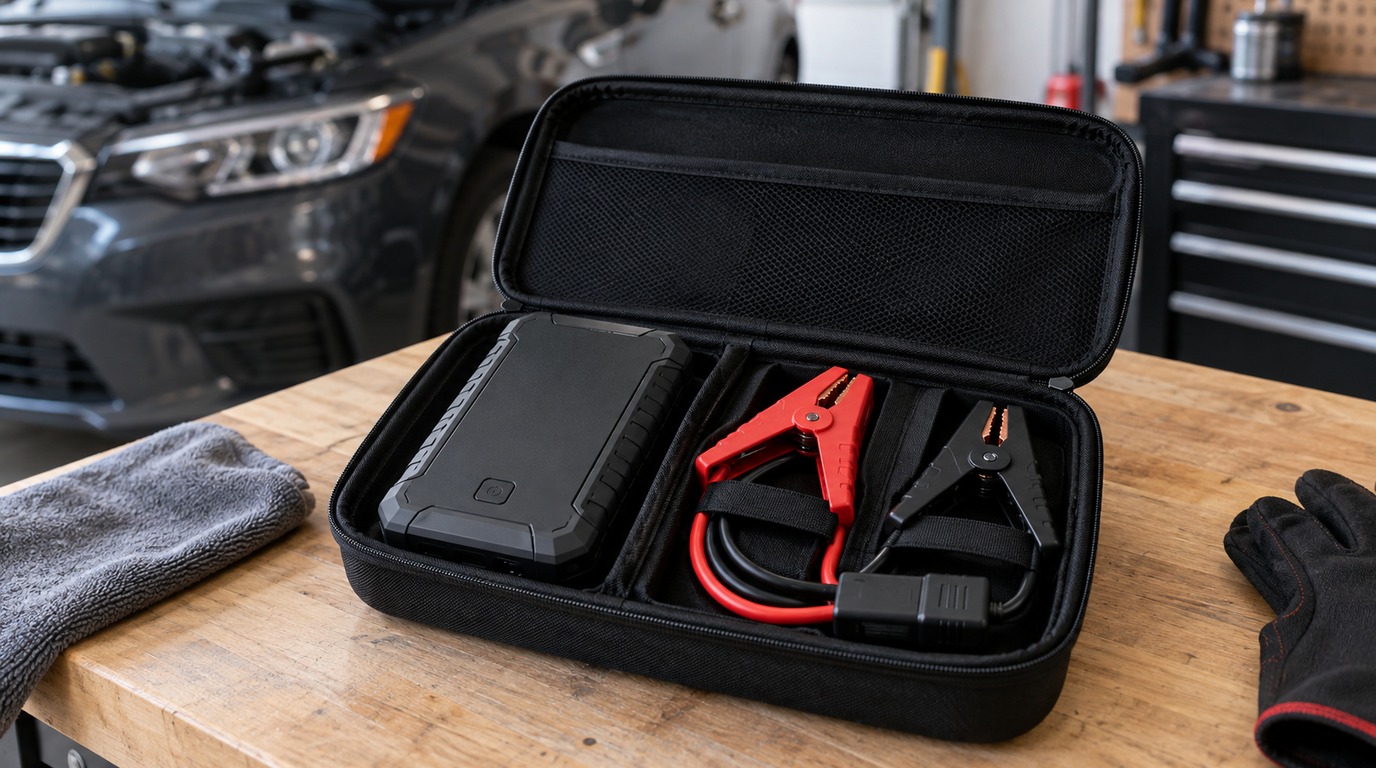
A portable jump starter removes the dependency on another vehicle for a dead battery — useful in a parking garage, at a trailhead, or anywhere you can’t or don’t want to flag someone down. Modern lithium jump starters are compact enough to keep in a glove box, powerful enough to start trucks and SUVs, and double as USB chargers for devices. Here’s what to buy in 2026.
Why Own a Portable Jump Starter?
- No need for another vehicle — jump yourself at any hour, anywhere
- Safer than jumper cables (smart clamps prevent incorrect polarity damage)
- Modern units are small enough to keep in the car permanently
- Useful as a USB power bank for devices on road trips
- One-time purchase vs potentially hundreds in roadside assistance calls
What to Look For
- Peak amps: The maximum instantaneous current for starting. For most cars: 1,000A peak is sufficient. Full-size trucks/large SUVs: 1,500–2,000A. Diesel trucks: 2,000A+.
- Cranking amps (CCA): More meaningful than peak amps but less commonly advertised. The sustained current at 0°F — what actually matters in cold weather.
- Battery capacity: Determines how many jumps per charge. 20,000–30,000mAh handles 20–30 attempts.
- Safety features: Reverse polarity protection is essential — smart clamps detect incorrect connection before allowing current to flow.
- Size and weight: Assess honestly what vehicle you’re starting and whether you’ll actually carry it.
Our Top Picks
Best Overall: Antigravity Batteries XP-10 (1000A Peak)
Antigravity Batteries is a US-based company originally known for lithium motorcycle batteries. Their XP-10 jump starter brings that same quality focus to the jump starter market. 1,000A peak handles virtually all cars, vans, and smaller SUVs with gas engines. Smart LED clamps with reverse polarity protection, a built-in 400-lumen flashlight, and USB-C (18W) + USB-A (10W) output for device charging. Compact and well-built. Around $80–100.
- Peak amps: 1,000A
- USB: USB-C 18W + USB-A 10W
- Best for: Most cars and vans, gas engines up to 6L
Best for Trucks and Professional Use: Clore Automotive JUMP-N-CARRY JNC660
The JNC660 is a lead-acid based unit — heavier than lithium alternatives but extremely reliable in cold weather and doesn’t require recharging between infrequent uses (lead-acid self-discharge is lower than lithium in storage). 1,700A peak, 425 cranking amps — handles full-size gas trucks and most diesels reliably. Clore is a professional-grade brand used by shops and fleets. If you drive a large truck or work in cold climates, this is the dependable choice. Around $100.
- Peak amps: 1,700A
- Type: Lead-acid (heavier but extremely cold-weather reliable)
- Best for: Trucks, SUVs, diesel, shop/fleet use, cold climates
Best Budget: GOOLOO GP4000 (4000A Peak)
GOOLOO offers strong specs at budget prices. The GP4000’s 4,000A peak rating is marketing-inflated (as are all jump starter peak amp claims at this price), but real-world performance handles most cars and many trucks reliably. Includes USB-C (65W PD) for fast-charging laptops, USB-A, and a built-in light. A good choice if you don’t want to spend $80+ on a device you hope to rarely use. Around $45–60.
- Peak amps: 4,000A (marketing claim — real-world closer to 1,500–2,000A effective)
- USB: 65W USB-C PD + USB-A
- Best for: Budget buyers, occasional use for cars and light trucks
Best Compact/Pocket: Antigravity XP-1
The XP-1 is genuinely pocket-sized — about the size of a thick credit card wallet. 600A peak, handles most small-to-mid size cars. Not for trucks or large SUVs but perfect for compact cars where carrying something bigger seems overkill. Antigravity’s build quality is noticeably better than typical budget pocket jump starters. Around $70.
Comparison Table
| Jump Starter | Peak Amps | Engine Size | USB Charging | Price |
|---|---|---|---|---|
| Antigravity XP-1 | 600A | Gas to 3L | USB-A | ~$70 |
| Antigravity XP-10 | 1,000A | Gas to 6L | USB-C 18W + USB-A | ~$90 |
| Antigravity XP-10-HD | 1,500A | Gas to 8L, Diesel to 5L | USB-C + USB-A | ~$130 |
| Clore JNC660 | 1,700A | Gas to 8L, Diesel | No | ~$100 |
| Clore JNC770R | 1,700A | Gas/Diesel, large | USB | ~$130 |
| GOOLOO GP4000 | 4,000A (mktg) | Gas to 8L | USB-C 65W + USB-A | ~$55 |
How to Use a Portable Jump Starter
After the vehicle starts, use the battery-versus-alternator diagnostic guide to investigate the cause; compare battery chargers and maintainers for charging and storage needs.
- Ensure the jump starter is charged (recharge after every use and every 3 months in storage)
- Turn off the vehicle
- Connect red clamp to positive (+) battery terminal
- Connect black clamp to an unpainted metal ground point on the engine block (preferred) or negative (-) terminal
- Wait 30 seconds for the unit to stabilize
- Start the vehicle — most start on the first attempt if the battery is simply discharged
- If it doesn’t start, wait 30 seconds and try again — no more than 3–4 attempts
- Remove clamps in reverse order (black first, then red)
- Drive or charge the vehicle to prevent immediate re-discharge
Frequently Asked Questions
How long does a portable jump starter hold its charge?
Quality lithium jump starters retain 70–80% charge after 12 months of storage. Recharge every 3–6 months even if unused. Lead-acid units (Clore JNC series) have lower self-discharge and can sit longer between charges — an advantage for infrequent use. After a jump start, recharge lithium units within 24 hours.
Can a portable jump starter damage my car’s electronics?
Units with smart/safe clamps are very safe — they detect connection orientation before allowing current to flow. Always use a unit with reverse polarity protection. Avoid very old or no-name units with simple metal clamps and no protection circuitry.
What’s the difference between peak amps and cranking amps?
Peak amps is maximum instantaneous current for milliseconds — the marketing number. Cranking amps (CCA) is sustained current over 30 seconds at a specific temperature. CCA is more meaningful for actual cold-weather starting performance but is less commonly specified. Treat peak amp claims — especially very high ones from budget brands — with skepticism.