For over three decades, lithium has reigned as the undisputed king of rechargeable battery chemistry. However, geopolitical supply-chain bottlenecks, environmental concerns regarding lithium extraction, and dramatic price volatility have spurred global chemical manufacturers to seek an alternative.
Enter Sodium-Ion (Na-Ion) technology. Led by battery industrial giants CATL, BYD, and Natron Energy, sodium-ion has officially transitioned from university research laboratories to full-scale commercial assembly lines. In this comprehensive guide, we examine how sodium-ion batteries work, compare them directly against LiFePO4 and lead-acid, and analyze their commercial roadmap.
How Sodium-Ion Chemistry Works
Electrochemically, sodium-ion batteries operate on the identical “rocking-chair” intercalation principle as lithium-ion batteries. During charging, ions are extracted from the cathode and travel through a liquid or solid electrolyte to insert themselves into the anode; during discharge, the process reverses.
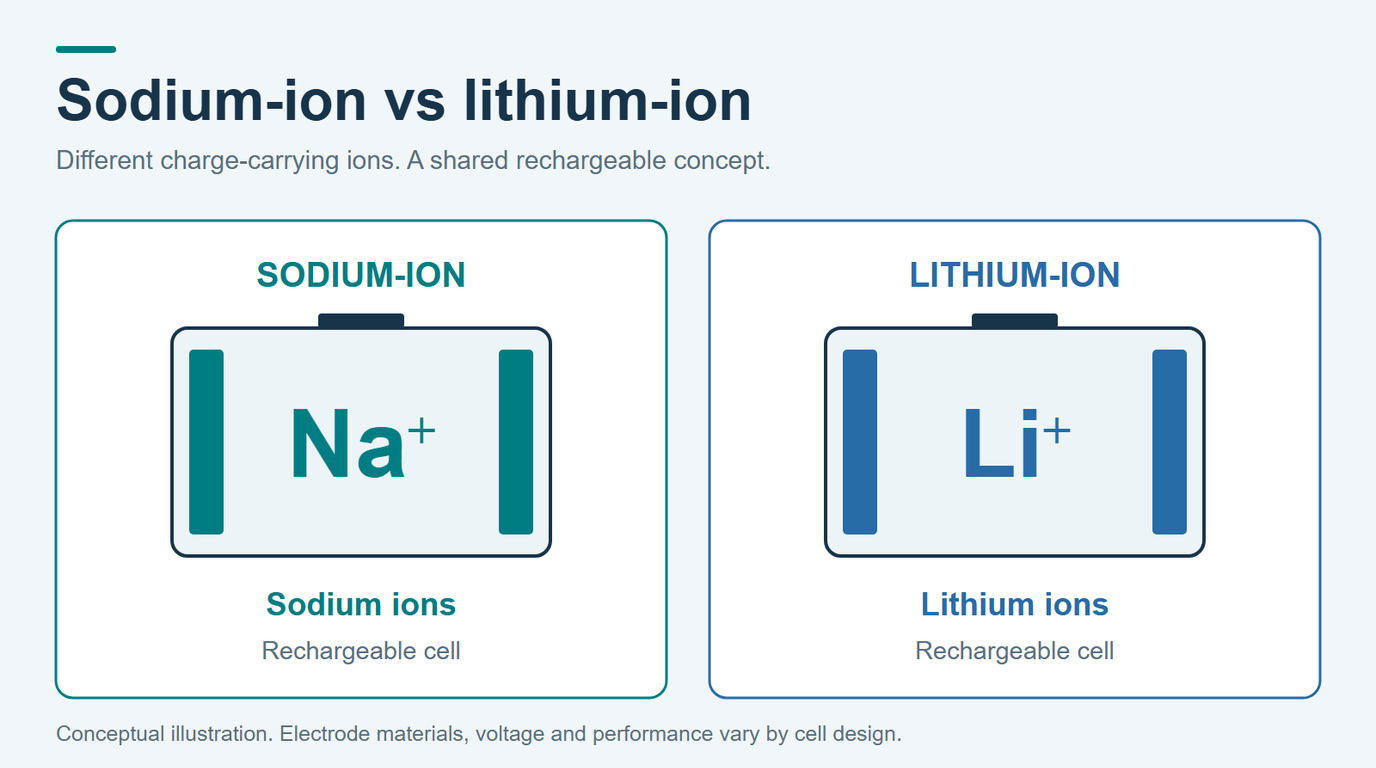
The critical difference lies in the charge carriers:
- Lithium (Li+): Ionic radius of 0.76 Å, atomic weight of 6.94. Extremely small and light, allowing high packing density into crystalline host materials.
- Sodium (Na+): Ionic radius of 1.02 Å, atomic weight of 22.99. Significantly larger and heavier than lithium.
Because sodium ions are approximately 35% larger than lithium ions, standard graphite anodes cannot accommodate them without exfoliating. Commercial sodium-ion cells instead utilize hard carbon (non-graphitizable carbon) anodes derived from sustainable biomass (such as biowaste, resin, or sugar precursors) with larger interstitial voids, paired with Prussian White or layered oxide cathodes.
Sodium-Ion vs. LiFePO4 vs. Lead-Acid: Full Spec Comparison
The LiFePO4 guide explains the established lithium alternative, while our solid-state battery explainer covers a different route to changing cell construction.
| Specification | Sodium-Ion (Na-Ion) | Lithium Iron Phosphate (LiFePO4) | AGM Lead-Acid |
|---|---|---|---|
| Raw Material Availability | Virtually Unlimited (Ocean salt) | Geographically restricted lithium | Moderate (Recycled lead) |
| Cell Energy Density (Wh/kg) | 140–165 Wh/kg | 160–210 Wh/kg | 30–50 Wh/kg |
| Cycle Life (80% DoD) | 3,000–5,000+ cycles | 3,500–6,000+ cycles | 300–600 cycles |
| Sub-Zero Performance (-20°C) | 88%–92% capacity retention | 60%–70% capacity retention | 50% capacity (Risk of freezing) |
| Fast Charging (0% to 80%) | 15 minutes (4C rate) | 45–60 minutes (1C rate) | 4–8 hours |
| Thermal Runaway Temperature | Exceeds 300°C (Extremely stable) | ~270°C | N/A (Off-gasses hydrogen) |
| Discharge to 0 Volts (Safe Transport) | Yes (Can be shipped completely dead) | No (Copper dissolution below 2.0V) | No (Permanent sulfation) |
| Projected Cost at Scale ($/kWh) | $35–$50 / kWh | $60–$85 / kWh | $100–$140 / kWh (Effective) |
The 4 Game-Changing Advantages of Sodium-Ion
1. Exceptional Cold-Weather Resilience
Lithium-ion batteries notoriously struggle in winter climates; electrolyte viscosity spikes, internal resistance soars, and lithium plating prevents fast charging below 0°C (32°F). In stark contrast, sodium-ion electrolyte chemistry maintains low desolvation energy at sub-zero temperatures. A commercial CATL sodium-ion cell retains over 90% of its rated capacity at -20°C (-4°F) and can still accept fast charging without cell degradation.
2. The 0-Volt Safety Breakthrough in Logistics
Due to safety regulations, lithium-ion batteries cannot be transported on commercial air cargo or sea containers below 30% state of charge, yet cannot be discharged to zero volts without dissolving their internal copper current collectors. Sodium-ion cells use inexpensive aluminum foil for both the cathode and anode current collectors (lithium attacks aluminum at low potentials, requiring costly copper foil). Because aluminum does not alloy with sodium at zero potential, sodium-ion batteries can be short-circuited and shipped at 0.00 Volts—completely inert, with zero chemical fire hazard during transit.
3. Freedom from Critical Mineral Cartels
Sodium is the sixth most abundant element in the Earth’s crust (constituting 2.6% of crustal mass compared to lithium’s 0.002%). Extracting sodium carbonate from trona ore or seawater costs a fraction of mining spodumene rock or evaporating brine in the South American Lithium Triangle. Furthermore, commercial sodium-ion cells require zero cobalt or nickel.
4. Direct Drop-In Manufacturing Compatibility
Unlike solid-state batteries—which require entirely new, multi-billion-dollar cleanroom roll-to-roll vacuum manufacturing facilities—sodium-ion slurry and cell winding can run on existing lithium-ion battery gigafactory production lines with minor tooling recalibrations.
Where Will You See Sodium-Ion First?
- Utility-Scale Battery Energy Storage (BESS): For solar and wind farms where weight is irrelevant and cost-per-kilowatt-hour is paramount, sodium-ion is replacing lead-acid and competing fiercely with LiFePO4.
- Budget Urban Commuter EVs: Small city cars with 150 to 220 miles of range in cold northern climates.
- Home Backup & Solar Generators: Residential batteries installed in unheated outdoor sheds and garages that face freezing winters.
- Telecom Towers and Data Centers: 48V telecom battery banks requiring zero maintenance and high thermal safety.
Frequently Asked Questions
Can I replace my 12V LiFePO4 battery with a Sodium-Ion battery today?
Not directly yet without checking voltage compatibility. A standard LiFePO4 cell has a nominal voltage of 3.2V (4 cells in series = 12.8V nominal). Commercial sodium-ion cells have a nominal voltage of 3.0V to 3.1V per cell. A 4-cell sodium pack produces 12.0V to 12.4V nominal. While compatible with most 12V inverters, custom charge profiles must be programmed into your solar charge controller.
Why aren’t sodium-ion batteries in smartphones or laptops?
Because of gravimetric and volumetric energy density. Flagship smartphones and slim laptops demand maximum battery capacity in minimum millimeter thickness. Premium NMC/silicon-anode lithium cells achieve 250 to 300 Wh/kg, whereas commercial sodium cells operate at 140 to 160 Wh/kg. A sodium-powered iPhone would either be 40% thicker or offer 40% less battery life.
Do sodium-ion batteries catch fire like lithium-ion?
Sodium-ion batteries are substantially safer and more thermally stable than conventional lithium-ion batteries. Nail-penetration tests, crushing, and severe overcharge testing show that sodium cells do not enter uncontrollable thermal runaway because their electrolyte flashpoint is higher and internal short-circuit heat dissipation is significantly faster.
Who are the leading companies producing sodium-ion batteries in 2026?
The global leaders include CATL (with their second-generation Na-ion cells achieving 160+ Wh/kg), BYD (FinDreams battery division), Natron Energy (specializing in Prussian Blue industrial UPS systems in the USA), and HiNa Battery.