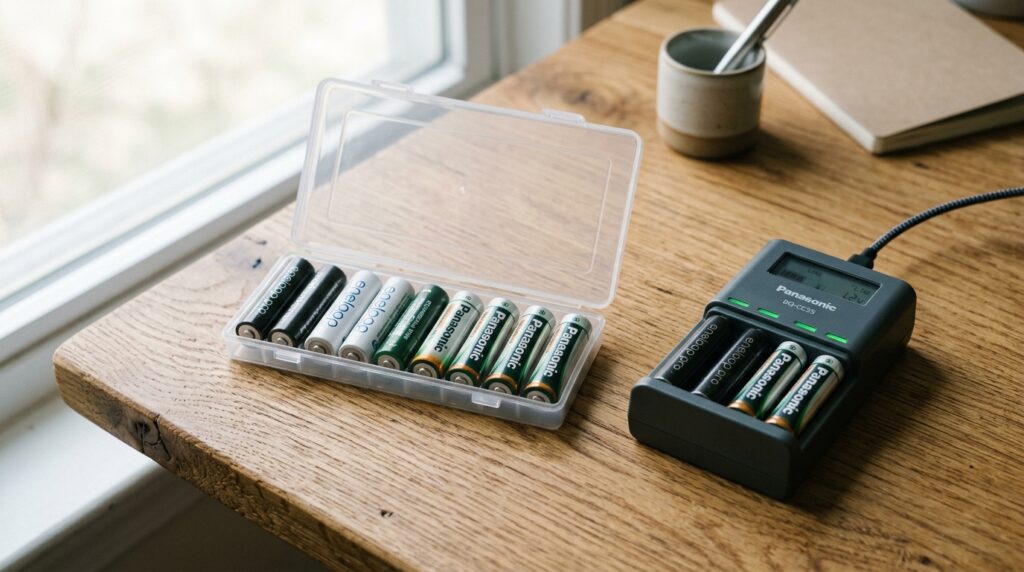
Switching to rechargeable AA batteries is one of the simplest ways to reduce both waste and long-term battery spending. The average household uses 30+ AA batteries per year — at $1–2 each for alkaline, that’s $30–60 annually on something a good set of rechargeable batteries can handle for years. This guide helps you choose the right ones for your specific use case.
Why Switch to Rechargeable AA?
- Cost savings: A set of 8 Eneloop batteries ($20–30) replaces 200+ alkaline batteries over their lifespan. At $1.50 per alkaline, that’s $300 saved per set.
- Environmental impact: Each rechargeable AA replaces 500–1,000 disposable batteries over its life, significantly reducing the environmental burden of battery production and disposal.
- Performance in high-drain devices: Rechargeable NiMH batteries (1.2V) maintain voltage more consistently under high drain than alkaline batteries (which sag from 1.5V to below 1.0V as they discharge). This is particularly noticeable in camera flashes, gaming controllers, and high-power flashlights.
What to Look For
- Capacity (mAh): Higher capacity = longer runtime per charge. Standard rechargeable AAs range from 1,700–2,550mAh. For comparison, typical alkaline AAs are rated at 2,500–3,000mAh but deliver less under high drain.
- Low self-discharge (LSD): Standard NiMH batteries lose 1–2% of charge per day when not in use. Low self-discharge batteries (Eneloop and similar) lose only 20–30% per year — meaning they’re ready to use after months of storage. LSD batteries are strongly preferred for most applications.
- Cycle count: How many charge/discharge cycles before significant capacity loss. Eneloop standard: 2,100 cycles. Eneloop Pro: 500 cycles (lower cycle count is the trade-off for higher capacity). For occasional users, cycle count matters less than capacity; for daily users, prioritize cycle count.
- Brand reliability: Battery capacity claims are frequently exaggerated by budget brands. Stick to established brands (Panasonic/Eneloop, Energizer, Duracell, Amazon Basics) for rated capacity you can trust.
Our Top Picks
Best Overall: Panasonic Eneloop AA (2000mAh, 2100 cycles)
The Eneloop has been the gold standard rechargeable AA for over 15 years for good reason. 2,000mAh capacity handles essentially all everyday applications, retains 70% charge after 10 years of storage (genuinely low self-discharge), and is rated for 2,100 charge cycles. The cells are made in Japan (most Eneloop competitors are made in China) and consistently test at or above rated capacity in independent reviews. Available in packs of 4–16.
Best for: TV remotes, clocks, mice, keyboard, smoke detectors, flashlights, children’s toys
Best High-Capacity: Panasonic Eneloop Pro (2550mAh, 500 cycles)
The Pro version trades cycle count (500 vs 2,100) for higher capacity (2550mAh vs 2000mAh). Worth choosing if you’re using batteries in high-drain devices (camera flash, wireless game controllers, high-powered LED flashlights) where runtime matters more than longevity. Not the right choice for low-drain devices like remotes that cycle rarely.
Best for: DSLR camera flashes, gaming controllers, high-drain flashlights
Best Budget: Amazon Basics High Capacity Rechargeable AA (2400mAh)
Amazon Basics rechargeable batteries are manufactured by Fujitsu (the same company as Eneloop’s parent manufacturer) and consistently test close to their rated capacity. At roughly 50–60% of Eneloop’s price, they’re an excellent choice for buyers who don’t need the 10-year charge retention or 2,100-cycle life of the Eneloop.
Best for: Cost-conscious buyers, devices used frequently enough that long shelf life doesn’t matter
Best for High-Drain Devices: Energizer Recharge Power Plus (2300mAh)
Energizer’s rechargeable line performs well in high-drain applications and is widely available at retail. Slightly lower cycle count than Eneloop (1,000 cycles) but good capacity and consistent performance. A solid choice if you can’t find Eneloop locally.
Comparison Table
| Battery | Capacity | Cycle Life | Self-Discharge | Price (8-pack) | Best For |
|---|---|---|---|---|---|
| Panasonic Eneloop | 2000mAh | 2,100 | Very low (70% after 10yr) | ~$20 | All-around, low-drain devices |
| Panasonic Eneloop Pro | 2550mAh | 500 | Low | ~$28 | High-drain devices |
| Amazon Basics High Cap | 2400mAh | ~1,000 | Low-moderate | ~$14 | Budget pick |
| Energizer Recharge Power Plus | 2300mAh | 1,000 | Low-moderate | ~$18 | High-drain, widely available |
| Duracell Rechargeable Ultra | 2500mAh | 400 | Moderate | ~$22 | Retail availability |
What Charger Should You Use?
The charger matters as much as the batteries. Avoid cheap dumb chargers that charge all cells together at a fixed rate with no individual monitoring — they overcharge full cells while trying to bring up weak ones, shortening battery life.
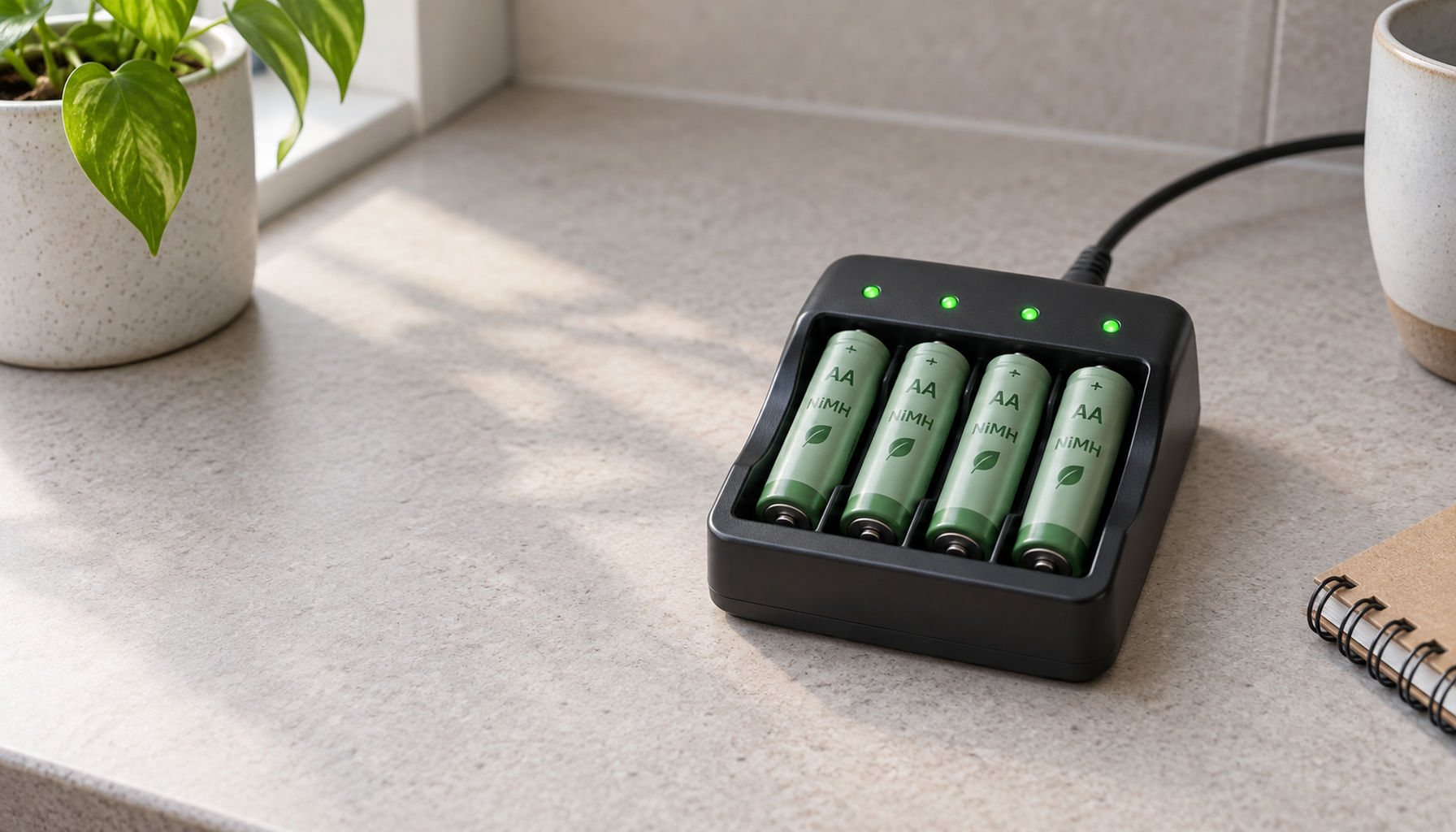
The NiMH battery guide explains the chemistry behind most rechargeable AA cells; the guide to mixing batteries covers why cells in a device should form a matched set.
- Panasonic Eneloop BQ-CC65 (or similar): Smart 4-channel charger that charges each cell individually, has LED indicators per channel, and includes a refresh/conditioning mode. The natural companion to Eneloop batteries.
- La Crosse BC-700: A step up for enthusiasts — individual channel monitoring, multiple charge/discharge modes, battery analyzer mode that measures actual capacity. The choice for anyone who wants to test and condition batteries.
- XTAR VC4S: LCD display showing individual cell voltage, capacity, and charge current. USB-C powered. Excellent for monitoring battery health over time.
Frequently Asked Questions
Can I use rechargeable AA batteries in all devices?
Rechargeable NiMH AAs output 1.2V vs 1.5V for alkaline. Most modern devices are designed to work with both. However, some devices with very low power requirements (small LED remotes, some clocks) are optimized for alkaline voltage and may show ‘low battery’ with rechargeable NiMH even at full charge — they’ll still work fine, just the indicator may be inaccurate. A small number of old devices explicitly state ‘do not use rechargeable batteries’ — check the manual.
How long do rechargeable AA batteries last?
Eneloop standard: rated for 2,100 cycles, which at one charge per week = 40 years. In practice, most people replace them after 10–15 years due to moderate capacity loss (to ~80% of original). Eneloop Pro: 500 cycles. Budget brands: 300–1,000 cycles. Actual lifespan depends heavily on charger quality — a good individual-channel charger extends battery life significantly compared to a dumb bulk charger.
Should I drain rechargeable batteries before recharging?
No — the ‘memory effect’ that required full discharge before recharging applied to old NiCd batteries, not modern NiMH. Modern NiMH rechargeable batteries can be recharged at any state of charge without harm. In fact, deep discharging NiMH batteries (below 0.9V per cell) can damage them. Recharge when convenient, not based on any fixed discharge schedule.